

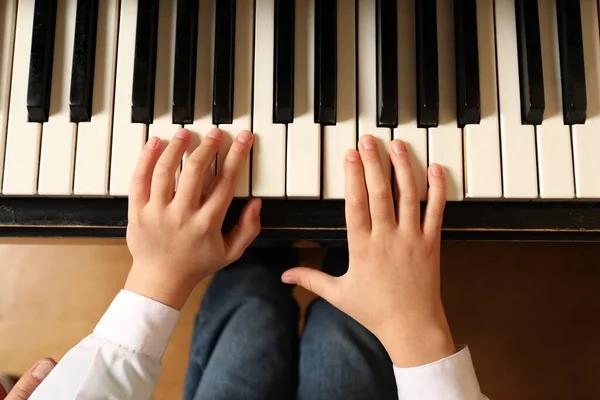
Learning to play the piano at home can provide a wealth of benefits, impacting not only musical abilities but also academic development and lifelong learning. Home piano lessons offer a unique blend of challenges and opportunities that foster intellectual growth in various spheres.
One primary advantage of home piano lessons is their ability to enhance cognitive skills. Learning to read music notation, understanding rhythm, pitch, and tone significantly improves children’s mathematical abilities. This is because playing the piano involves counting notes and rhythms which indirectly instills numerical acuity. Additionally, it enhances spatial-temporal skills necessary for solving complex math problems.
Moreover, studying music has been linked with improved language skills. While deciphering sheet music, a student essentially learns a new language full of symbols representing sounds just like words represent ideas or objects in verbal communication. This process aids in improving vocabulary and reading comprehension skills as it involves similar patterns recognition.
Home piano lessons also foster critical thinking and problem-solving abilities. When students encounter challenging pieces of music, they must find ways to overcome these hurdles by analyzing the piece’s structure or breaking it down into smaller sections – an approach applicable to many academic scenarios.
On top of cognitive benefits, home-based piano instruction promotes self-discipline and time management – crucial life skills that translate well into academic performance as well as professional life later on. It requires consistent practice sessions which demand commitment and perseverance from learners while teaching them how to manage their time effectively.
Furthermore, playing the piano boosts self-esteem by providing tangible goals for students to strive towards such as mastering a difficult piece or performing for others. Achieving these milestones nurtures confidence which carries over into other aspects including schoolwork where they are likely click to learn more actively thus enhancing their overall learning experience.
In terms of lifelong learning benefits beyond academia; playing the piano fosters emotional expression enabling individuals better articulate feelings through melody – an invaluable tool for personal growth throughout one’s life journey. Music serves as an outlet where individuals can express themselves creatively, enhancing their emotional intelligence and empathy towards others.
Moreover, the joy of playing piano keeps the brain active in old age. Regular engagement with music can slow cognitive decline associated with aging, keeping minds sharp and agile for longer periods.
In conclusion, home piano lessons offer a holistic approach to learning that extends beyond musical proficiency. They contribute significantly to academic development by improving mathematical abilities, language skills, critical thinking, problem-solving abilities, self-discipline and time management. In addition to these academic benefits; they foster emotional expression and keep brains active promoting lifelong learning. Therefore incorporating home piano lessons into children’s routines could prove instrumental in their overall intellectual growth and personal development journey.
